AI Voice Agents vs Call Centers: Which Is Better?
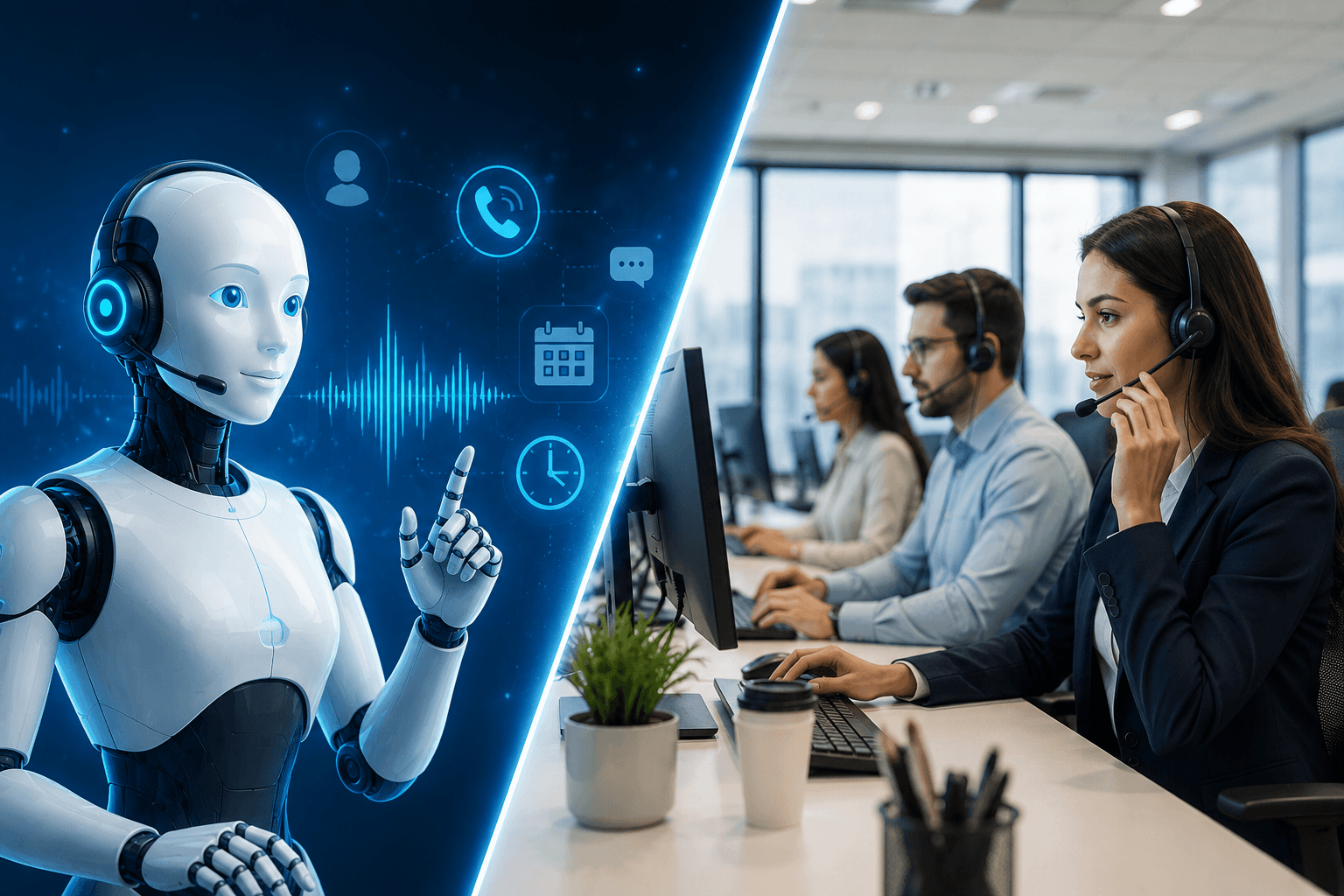
AI Voice Agents vs Call Centers: Which Is Better for Your Business?
Businesses today receive more customer calls than ever. From answering basic questions and qualifying leads to booking appointments and handling support requests, phone communication remains an important part of customer service.
Traditionally, businesses have relied on call centers and human agents to manage these conversations. But with the rise of artificial intelligence, AI Voice Agents are changing how companies handle incoming and outgoing calls.
So, which option is better for your business: AI Voice Agents or traditional call centers?
The answer depends on your call volume, business requirements, customer expectations, and the type of conversations you need to manage. Let's compare both solutions and understand where each one works best.
What Is a Traditional Call Center?
A traditional call center relies on human customer service representatives to handle phone conversations.
When a customer calls, an agent answers the phone, understands the customer's request, provides assistance, and takes the necessary action.
Call centers are commonly used for:
- Customer support
- Sales calls
- Lead generation
- Order inquiries
- Technical support
- Appointment management
- Billing questions
- Customer complaints
- Follow-up calls
Human agents are particularly valuable when conversations require empathy, judgment, negotiation, or complex problem-solving.
However, traditional call centers also come with operational challenges. Businesses may need to hire and train employees, manage shifts, handle employee turnover, and maintain enough staff to handle peak call volumes.
What Is an AI Voice Agent?
An AI Voice Agent is an AI-powered system that can communicate with customers over the phone using natural language.
Instead of following a simple keypad menu, customers can speak naturally and explain what they need.
For example, instead of hearing:
"Press 1 for Sales. Press 2 for Support."
A customer can simply say:
"I want to know more about your pricing."
The AI Voice Agent can understand the request, respond with relevant information, ask follow-up questions, collect details, and transfer the call to a human when necessary.
AI Voice Agents can be used for:
- Answering incoming calls
- Lead qualification
- Appointment scheduling
- Customer FAQs
- Order inquiries
- Outbound calls
- Customer follow-ups
- Call routing
- After-hours support
- Data collection
AI Voice Agents vs Call Centers: The Key Difference
The biggest difference is how customer conversations are handled.
A traditional call center depends primarily on human employees. An AI Voice Agent uses artificial intelligence to automate conversations and routine tasks.
Think of it this way:
Traditional Call Center = Human-powered customer communication
AI Voice Agent = AI-powered conversational automation
This doesn't necessarily mean businesses have to choose one and completely eliminate the other. In many cases, combining AI with human agents can create a more efficient customer service operation.
1. Availability
One of the biggest advantages of AI Voice Agents is their ability to provide continuous call coverage.
A traditional call center usually operates according to employee schedules and business hours. Extending coverage may require additional shifts and staff.
AI Voice Agents can answer calls 24/7, including evenings, weekends, and holidays.
This can help businesses respond to customers faster and reduce the number of missed calls.
For companies that receive inquiries outside normal business hours, this can make a significant difference.
2. Handling High Call Volumes
Call volume can change dramatically throughout the day.
A traditional call center may become overwhelmed when many customers call at the same time. Long waiting times can lead to frustrated customers and abandoned calls.
AI Voice Agents can handle large numbers of repetitive conversations without requiring a proportional increase in staff.
For example, an AI agent can simultaneously handle common questions, collect customer information, qualify leads, or schedule appointments while human employees focus on more complex cases.
3. Customer Experience
Human agents provide something AI cannot completely replace: human empathy and judgment.
A customer dealing with a complicated complaint may prefer speaking directly with a person.
However, AI Voice Agents can make simple interactions much faster.
Instead of waiting for an employee to answer a basic question, customers can immediately receive information about:
- Business hours
- Pricing
- Services
- Appointment availability
- Order status
- Frequently asked questions
The best customer experience often comes from using AI for simple and repetitive requests while allowing human agents to handle conversations that require personal attention.
4. Lead Qualification
Lead qualification is another area where AI Voice Agents can be extremely useful.
In a traditional call center, employees may spend a significant amount of time asking the same qualification questions to every prospect.
An AI Voice Agent can automate the initial conversation.
It can ask questions such as:
- What service are you interested in?
- When do you need the service?
- What is your budget?
- What type of solution are you looking for?
- How soon would you like to get started?
The collected information can then be passed to the sales team.
This allows human sales representatives to spend more time talking to qualified prospects instead of handling every initial inquiry manually.
5. Appointment Scheduling
Appointment booking is another repetitive task that can often be automated.
A customer could simply say:
"I'd like to book an appointment for Friday."
An AI Voice Agent can collect the necessary information and connect the conversation with the appropriate scheduling workflow, depending on the business setup.
This can be useful for:
- Clinics
- Salons
- Consultants
- Repair businesses
- Professional services
- Home service companies
Instead of having an employee answer every appointment call, AI can handle the routine parts of the process.
6. Cost and Operational Efficiency
The cost of running a traditional call center depends on factors such as employee salaries, recruitment, training, management, office infrastructure, and call volume.
AI Voice Agents can reduce the amount of repetitive work handled by human employees.
The goal isn't necessarily to replace an entire call center.
Instead, businesses can use AI to automate repetitive conversations and allow employees to focus on higher-value activities.
For example, an AI Voice Agent could handle hundreds of routine inquiries while human representatives focus on sales, complex support issues, and customer relationships.
Over time, this can improve operational efficiency.
7. Scalability
As a business grows, its customer communication requirements usually grow as well.
With a traditional call center, increasing capacity may require hiring more employees, adding shifts, and providing additional training.
AI Voice Agents offer a more flexible approach.
Businesses can use AI to handle routine conversations as call volumes increase without having to expand the human team at the same rate.
This makes AI Voice Agents particularly useful for businesses experiencing rapid growth or seasonal increases in demand.
8. Human Agents Are Still Important
AI Voice Agents don't mean human customer service is no longer necessary.
There will always be situations where customers need to speak with a real person.
For example, a customer may have a complicated billing problem, a sensitive complaint, or a request that requires human judgment.
This is where AI + Human Support becomes powerful.
An AI Voice Agent can handle the initial conversation, understand the customer's intent, collect relevant information, and then transfer the call to the appropriate employee.
This creates a hybrid workflow:
AI handles repetitive tasks → Human agents handle complex conversations.
AI Voice Agents vs Call Centers: Quick Comparison
| Feature | Traditional Call Center | AI Voice Agents |
|---|---|---|
| Availability | Based on staff schedules | 24/7 capability |
| Call Handling | Human-powered | AI-powered |
| Scalability | Requires more staff | Highly scalable |
| Lead Qualification | Usually manual | Can be automated |
| Appointment Scheduling | Often manual | Can be automated |
| Repetitive Questions | Handled by agents | AI can handle automatically |
| Complex Conversations | Excellent | Human escalation available |
| Natural Conversations | Yes | Yes |
| Response Time | Depends on availability | Immediate for supported tasks |
| Human Empathy | Strong | Limited |
| Operational Efficiency | Staff-dependent | Highly automated |
Which One Is Better for Your Business?
There isn't a single solution that works for every business.
A traditional call center may be the better choice when your business requires:
- Complex customer interactions
- Personalized support
- Negotiation
- Human empathy
- Detailed problem-solving
- Relationship-based sales
An AI Voice Agent may be the better option when your business needs:
- 24/7 call answering
- Automated FAQs
- Lead qualification
- Appointment scheduling
- High-volume call handling
- Faster responses
- Reduced repetitive workload
- Automated customer follow-ups
For many businesses, the strongest solution is actually a combination of both.
AI Voice Agents and Call Centers Can Work Together
The future of customer communication doesn't necessarily have to be AI vs humans.
Instead, businesses can combine AI Voice Agents with human call center teams.
For example:
- A customer calls the business.
- The AI Voice Agent answers immediately.
- The AI identifies the reason for the call.
- It handles the request if it is routine.
- The AI collects relevant information.
- A human agent receives the call when human assistance is required.
This approach allows businesses to automate repetitive tasks while keeping human support available for situations that need it.
How AI Voice Agents Fit Into Modern Business Communication
AI Voice Agents are becoming part of a broader shift toward intelligent business communication.
Modern businesses don't just need a phone system that connects calls. They need communication systems that can understand customer intent, automate workflows, capture information, and connect conversations with other business processes.
For businesses exploring this transition, understanding the difference between AI Voice Agents and traditional phone infrastructure is an important first step.
If you're also interested in how AI Voice Agents compare with traditional PBX systems, check out our related guide: AI Voice Agents vs Traditional PBX: What's the Difference?.
Final Thoughts
AI Voice Agents and traditional call centers both have an important role in business communication.
Call centers provide human interaction, empathy, and problem-solving capabilities. AI Voice Agents provide automation, scalability, continuous availability, and faster handling of repetitive conversations.
For many businesses, the question isn't whether AI should completely replace human agents.
The better question is:
Which conversations should AI handle, and which conversations should be handled by people?
By combining AI Voice Agents with human support, businesses can reduce repetitive workloads, respond to customers faster, improve lead management, and create a more scalable customer communication system.
As AI technology continues to improve, businesses that adopt intelligent voice automation can build more efficient and responsive customer experiences while keeping human support where it matters most.
To explore AI-powered voice automation for your business, visit iCallAgent.