AI Voice Agents vs Human Agents: Future of Automation | DataGuru
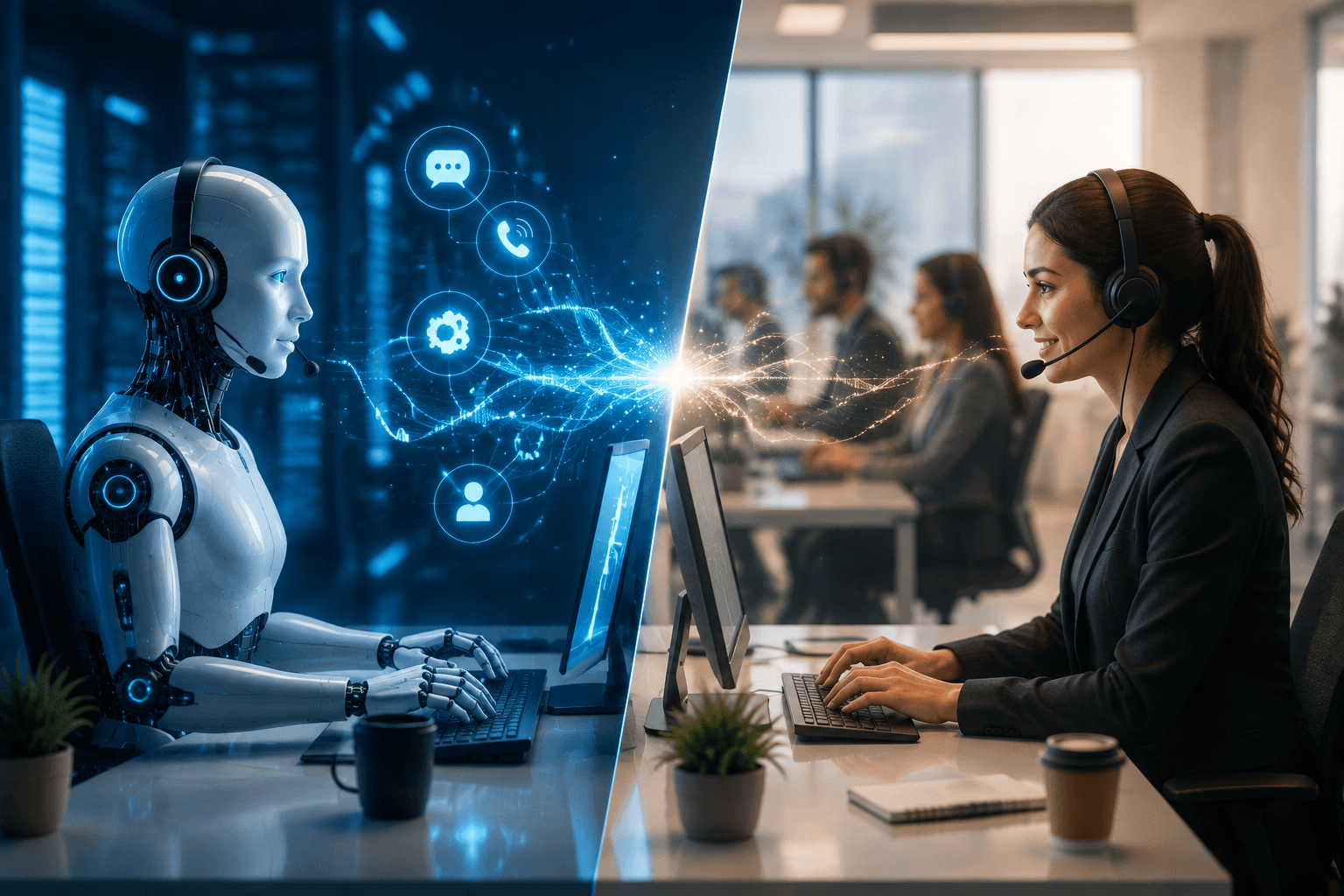
Introduction: The Changing Landscape of Business Communication
Businesses are constantly searching for better ways to manage customer interactions, automate repetitive processes, and improve operational efficiency. While human agents have traditionally powered customer service and business communication, AI agents are changing how organizations handle conversations and workflows.
With solutions like DataGuru AI Agents, companies can automate digital tasks, streamline operations, and build intelligent systems that work alongside human teams.
The question is no longer whether AI will impact business operations. The real question is: Will AI voice agents replace human agents, or will the future belong to a collaborative combination of both?
This article explores the key differences between AI voice agents and human agents, their unique strengths and limitations, and how forward-thinking businesses can leverage both technologies to create smarter, more agile operations.
What Are AI Voice Agents?
AI voice agents are intelligent software systems designed to communicate with users through natural language conversations. Unlike traditional automated systems that follow fixed, rigid scripts, modern AI agents can understand context, process information, and complete complex tasks autonomously.
AI voice agents help modern businesses:
- Answer customer inquiries instantaneously without placement on hold
- Schedule and reschedule appointments directly within calendar platforms
- Qualify leads by asking targeted pre-screening questions
- Provide 24/7 support across different languages and time zones
- Handle high-volume, repetitive requests without fatigue
- Automate follow-up communications and notification workflows
Powered by machine learning, natural language processing (NLP), and speech recognition, AI agents allow businesses to deliver faster, more consistent customer experiences at scale.
What Are Human Agents?
Human agents are skilled professionals who engage directly with customers to solve problems, deliver empathetic guidance, and manage nuanced situations. They possess key capabilities that artificial systems cannot replicate:
- Deep emotional intelligence and empathy during sensitive interactions
- Personal judgment and critical thinking for ambiguous scenarios
- Complex problem-solving when handling out-of-policy exceptions
- Relationship building for high-value clients and enterprise accounts
- Adaptability when facing unexpected or unique challenges
However, relying exclusively on human-based operations presents inherent operational constraints:
- Constrained working hours and limited shift coverage
- Higher operational costs per interaction
- Ongoing onboarding and training requirements
- Scaling friction during sudden spikes in call volume
AI Voice Agents vs. Human Agents: Key Differences
To understand where each type of agent excels, it helps to analyze their core operational capabilities side-by-side:
| Operational Dimension | AI Voice Agents | Human Agents |
| Availability | 24/7/365 continuous operation | Shift-based / Business hours coverage |
| Response Speed | Instant zero-wait resolution | Variable (subject to call queues) |
| Concurrency & Scale | Handles thousands of calls simultaneously | Limited to 1 live call per agent |
| Cost Efficiency | Low marginal cost per interaction | High salary, training, & overhead costs |
| Emotional Intelligence | Configured/scripted tone adaptation | Genuine empathy & rapport building |
| Handling Ambiguity | Best within structured workflows | Excels at complex, novel problems |
| Consistency | Uniform adherence to rules & policies | Subject to agent variance & fatigue |
1. Availability and Scalability
One of the biggest advantages of DataGuru AI Agents is continuous availability. AI systems operate 24/7 across thousands of simultaneous conversations without downtime or breaks. Human agents are limited by shift capacities; scaling during peak traffic requires hiring and training additional headcount.
2. Speed of Response
Customers expect immediate solutions. AI voice agents instantly fetch account details, query internal systems, and resolve basic tasks within seconds. Human agents require time to look up records, consult knowledge bases, and navigate multiple software tools during a live call.
3. Cost Efficiency
Human support teams require salaries, benefits, infrastructure, and continuous management. Implementing DataGuru AI Agents automates routine interactions at a fraction of the cost, enabling organizations to redirect human staff toward high-impact strategic growth initiatives.
Where Human Agents Still Have an Advantage
Despite rapid advancements in artificial intelligence, human agents remain irreplaceable in several core domains:
Emotional Intelligence and Crisis De-escalation
Sensitive customer situations—such as severe billing disputes, formal complaints, or emotional distress—demand human empathy. Human representatives convey warmth and genuine understanding, building trust and preserving long-term brand loyalty.
Complex Decision-Making and Discretion
When dealing with out-of-policy requests or multifaceted technical issues, human agents utilize context, judgment, and past experience to negotiate creative solutions that AI workflows are not programmed to handle.
How DataGuru AI Agents Support Modern Businesses
DataGuru provides enterprise-grade intelligent automation solutions designed to eliminate operational bottlenecks, reduce manual friction, and accelerate workplace productivity.
1. Intelligent Workflow Automation
Organizations build custom AI-powered workflows that execute repetitive tasks automatically, including document parsing, browser automation, and multi-system data syncs.
2. Automated Data Extraction & Processing
Modern enterprises generate massive volumes of unstructured data. DataGuru AI Agents collect, extract, organize, and transform raw caller inputs into structured CRM insights in real time.
3. Scalable Digital Workforces
By offloading high-frequency, low-complexity tasks to virtual agents, companies reduce operational overhead, maintain high precision, and easily absorb seasonal call volume spikes.
The Future: A Collaborative Hybrid Model
The future of business automation is not a zero-sum replacement of human staff by AI. Instead, top-performing organizations deploy a hybrid collaborative framework:
- AI Voice Agents manage frontline triage, high-volume FAQs, routine scheduling, and data entry.
- Human Agents handle high-tier escalations, strategic client relationships, complex negotiations, and empathetic resolutions.
In this model, AI handles the operational heavy lifting while human professionals focus on high-value tasks requiring discretion, creativity, and human connection.
Why Businesses Are Rapidly Adopting AI Automation
- Higher Productivity: Staff shift focus from mundane tasks to strategic problem-solving.
- Superior Customer Experiences: Zero queue times and consistent policy execution boost satisfaction scores.
- Reduced Operating Costs: Lower cost-per-contact across all customer service channels.
- Elastic Scalability: Scale service capacity up or down instantly without altering headcount.