Conversational AI vs. Traditional IVR: Key Differences Explained
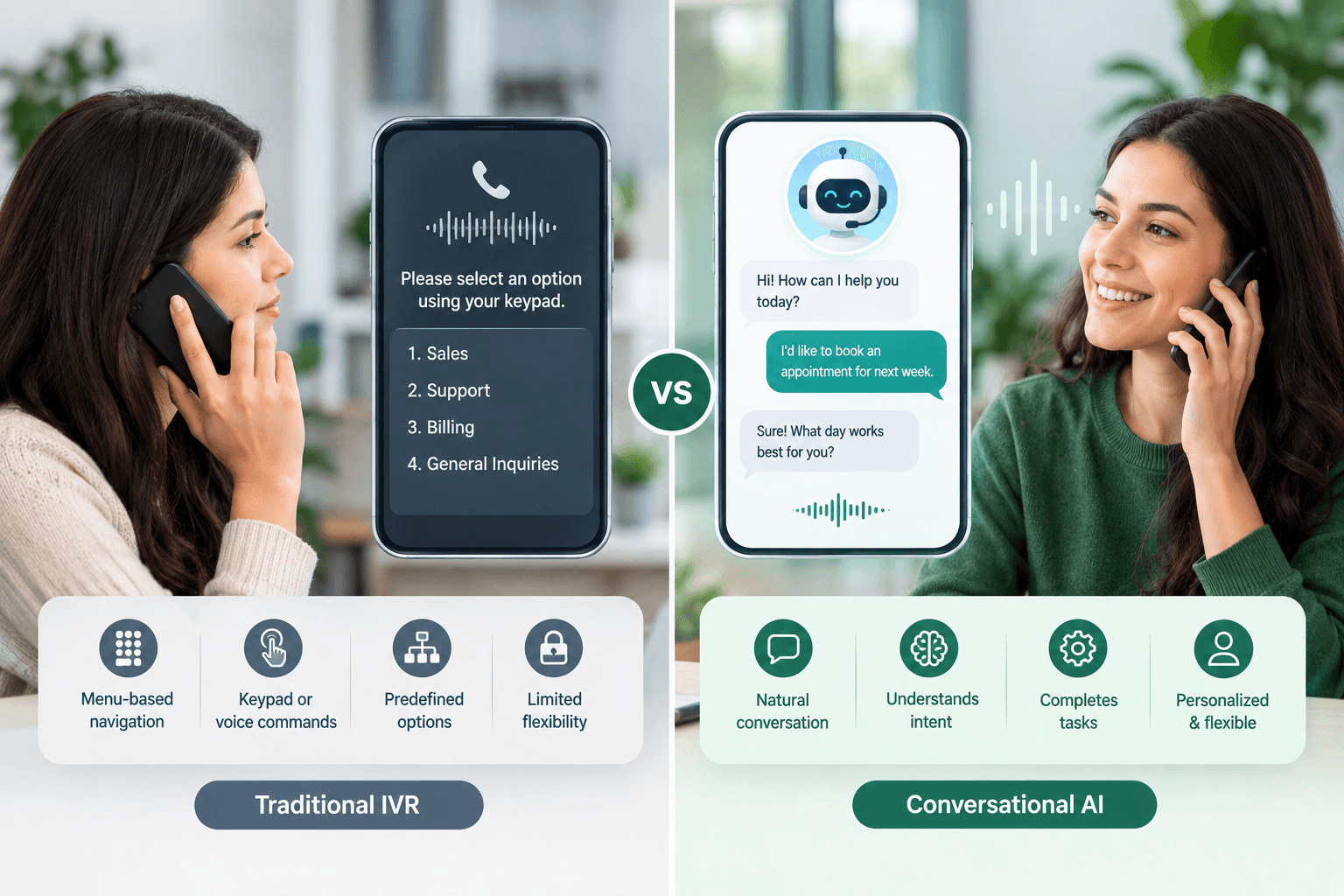
Conversational AI vs. Traditional IVR: What’s the Difference?
Phone communication remains an important part of customer service and business operations. Customers call businesses to ask questions, get support, book appointments, check information, or speak with a representative.
For many years, businesses have relied on Interactive Voice Response (IVR) systems to manage incoming calls. IVR systems allow callers to navigate phone menus using keypad selections or voice commands.
However, conversational AI is changing how businesses manage phone conversations.
Instead of asking customers to select options from a fixed menu, conversational AI can understand natural language, respond to questions, collect information, and complete specific tasks through a more natural conversation.
So, what is the difference between conversational AI vs. traditional IVR, and when should businesses use each approach?
What Is Traditional IVR?
Traditional IVR is an automated telephone system that guides callers through predefined menus.
A typical IVR interaction might sound like:
“Press 1 for Sales. Press 2 for Support. Press 3 for Billing.”
The caller then selects an option and moves through another menu or gets transferred to the appropriate department.
IVR systems can help businesses organize incoming calls and route customers without requiring a human representative to answer every call.
Common IVR Functions
Traditional IVR systems can be used for:
- Call routing
- Department selection
- Account information
- Basic self-service
- Payment-related options
- Business-hour information
- Customer identification
- Call transfers
- Frequently requested information
IVR works particularly well when customer requests are predictable and can be handled through a structured menu.
What Is Conversational AI?
Conversational AI uses artificial intelligence and voice technology to interact with people using natural language.
Rather than requiring customers to follow a rigid menu, an AI voice agent can understand what the caller is trying to accomplish and respond accordingly.
For example, instead of:
“Press 1 for appointments.”
A conversational AI system could allow the customer to say:
“I'd like to schedule an appointment for tomorrow.”
The AI can then continue the conversation, ask for the required information, check the relevant workflow, and help move the request forward.
Depending on the system and integrations, conversational AI can support tasks such as:
- Answering customer questions
- Collecting customer information
- Qualifying leads
- Scheduling appointments
- Confirming appointments
- Rescheduling appointments
- Cancelling appointments
- Following up with leads
- Answering frequently asked questions
- Routing calls to human representatives
- Handling inbound and outbound conversations
- Triggering business workflows
Conversational AI vs. Traditional IVR: The Key Difference
The biggest difference is how customers interact with the system.
Traditional IVR generally requires customers to navigate predefined options.
Conversational AI allows customers to communicate more naturally.
| Feature | Traditional IVR | Conversational AI |
|---|---|---|
| Interaction | Menu-based | Natural conversation |
| Customer input | Keypad or limited commands | Natural language |
| Call routing | Predefined options | Intent-based routing |
| FAQs | Fixed recordings or menus | AI-generated responses based on knowledge |
| Lead qualification | Limited | Can ask qualifying questions |
| Appointment scheduling | Usually requires integration | Can be part of an AI workflow |
| Follow-ups | Limited or separate systems | Can support automated workflows |
| Flexibility | Structured | More adaptable |
| Human handoff | Yes | Yes |
| Complex conversations | Limited | Better suited for multi-step conversations |
The important distinction is not simply that one system is automated and the other is not. Both can automate calls. The difference is the way they understand and manage the conversation.
How Traditional IVR Works
A traditional IVR usually follows a predefined decision tree.
For example:
Caller → Main Menu → Department → Submenu → Action → Representative
If a customer wants support, they may need to select several options before reaching the correct department.
This structure can work well for simple and predictable requests.
However, customers may become frustrated when they cannot find an option that matches their situation.
For example, a customer might say:
“I need to change my appointment and also have a question about the service.”
A traditional menu may force the caller to choose one category before continuing.
How Conversational AI Works
Conversational AI takes a more flexible approach.
Instead of starting with a long list of options, the system can begin with an open-ended question such as:
“How can I help you today?”
The caller can explain their request naturally.
The AI can then identify the caller's intent and determine the appropriate next step.
For example:
Caller: “I want to book a consultation for next week.”
AI: “Sure. What day works best for you?”
The conversation can continue based on the caller's responses.
This makes the interaction feel closer to a conversation with a human representative rather than navigating a telephone menu.
1. Customer Experience
Customer experience is one of the biggest differences between conversational AI and traditional IVR.
Traditional IVR can require customers to listen to several options before selecting the appropriate one.
Conversational AI can reduce this friction by allowing callers to explain what they need.
Instead of navigating:
Press 1 → Press 2 → Press 3 → Enter information
the customer can simply describe the request.
This can make the interaction more direct and easier to understand.
2. Understanding Customer Intent
Traditional IVR generally depends on predefined paths.
If the customer's request does not fit the available options, they may need to return to the main menu or speak with an employee.
Conversational AI can identify intent from natural language.
For example, these requests could represent a similar intent:
- “I need to book a meeting.”
- “Can I schedule a consultation?”
- “I'd like to arrange an appointment.”
- “Can someone book me in for tomorrow?”
A conversational AI system can be designed to recognize the purpose behind these different expressions.
3. Lead Qualification
Traditional IVR is primarily designed for routing and structured self-service.
Conversational AI can support more detailed lead qualification.
For example, an AI voice agent can ask:
- What service are you interested in?
- What is your approximate budget?
- When do you need the service?
- What type of solution are you looking for?
- What is the best way to contact you?
The collected information can then be used by the sales team to understand the lead before continuing the conversation.
4. Appointment Scheduling
Appointment management is another area where conversational AI can support business workflows.
A customer can ask to book, reschedule, or cancel an appointment through a voice conversation.
The AI can collect the required details and, when connected to the appropriate scheduling system, help complete the next step.
This can reduce repetitive scheduling work for employees.
5. Handling FAQs
Businesses receive many repetitive questions.
Customers may repeatedly ask about:
- Services
- Pricing
- Opening hours
- Locations
- Availability
- Processes
- Booking information
- Policies
A traditional IVR may provide recorded information or direct the caller to a department.
Conversational AI can provide answers through a more interactive conversation, provided the AI has access to accurate business knowledge.
6. Human Handoff
Conversational AI does not have to replace human representatives.
In many business workflows, AI and human agents can work together.
The AI can handle initial conversations and repetitive requests while transferring more complex situations to a human representative.
For example:
Caller → AI conversation → Information collected → Qualified request → Human sales representative
This approach allows employees to focus on conversations that require human judgment, negotiation, or specialized expertise.
When Is Traditional IVR Still Useful?
Traditional IVR remains useful for businesses that need simple, structured call routing.
For example, a company may only need callers to choose between:
Sales → Support → Billing
In these situations, a traditional IVR can provide a straightforward way to organize incoming calls.
IVR can also be useful when businesses have established phone systems and do not require natural-language conversations.
The right choice depends on the complexity of the customer journey and the type of automation the business needs.
When Should Businesses Consider Conversational AI?
Conversational AI may be useful when businesses need more than basic call routing.
It can be particularly relevant for organizations that:
- Receive high call volumes
- Need faster responses
- Want to qualify leads automatically
- Handle repetitive customer questions
- Schedule appointments
- Need inbound and outbound calling
- Want automated follow-ups
- Need to collect information during calls
- Want to connect phone conversations with business workflows
- Need after-hours call handling
The goal is not necessarily to remove every traditional phone system.
Instead, businesses can use conversational AI where natural conversations and workflow automation provide additional value.
Conversational AI and IVR Can Work Together
Businesses do not always have to choose one technology exclusively.
Conversational AI can be integrated into a broader call-handling system.
For example:
Incoming Call → AI Understands Request → Customer Information Collected → Appropriate Workflow → Human Transfer When Needed
A business could also use traditional IVR for specific routing requirements while using conversational AI for more complex customer interactions.
This hybrid approach can combine structured routing with natural-language interaction.
What Should Businesses Consider Before Choosing?
Before replacing or upgrading an existing phone system, businesses should consider several factors.
Call Volume
Businesses handling a large number of calls may benefit from greater automation.
Conversation Complexity
Simple routing may work well with traditional IVR, while multi-step conversations may require more flexible AI capabilities.
Integration Requirements
Businesses should consider whether the system needs to connect with calendars, CRMs, customer databases, communication platforms, or other business tools.
Human Handoff
A good automated system should have a clear process for transferring conversations to human representatives when necessary.
Business Knowledge
AI systems need reliable information to provide useful and accurate responses.
Customer Experience
Businesses should evaluate whether the technology makes it easier for customers to accomplish what they called about.
The Future of Business Phone Automation
Business phone systems are moving beyond simple menu-based automation.
Modern AI voice technology can connect conversations with broader business workflows.
A single call can potentially involve:
Conversation → Information Collection → Qualification → Scheduling → CRM Update → Follow-Up
This means the value of AI voice technology is not only in answering calls. It can also help connect customer conversations with the actions that happen after the call.
Conversational AI vs. Traditional IVR: Which Approach Fits Your Business?
Traditional IVR and conversational AI serve different purposes.
Traditional IVR is built around structured menus and predefined call-routing paths. It can be useful for simple and predictable customer interactions.
Conversational AI is designed for more natural interactions. It can understand customer requests, ask follow-up questions, collect information, support lead qualification, and work with business workflows.
For businesses looking to automate more than basic call routing, AI voice agents can provide a way to build a more flexible phone experience.
The key is to choose the technology based on the actual customer journey, call volume, business workflows, and level of automation required.
Final Thoughts
The difference between conversational AI vs. traditional IVR comes down largely to how customers communicate with the system.
Traditional IVR guides customers through predefined options, while conversational AI allows customers to communicate more naturally.
For simple call routing, traditional IVR can remain useful. For businesses that need lead qualification, appointment scheduling, customer information collection, follow-ups, FAQs, and more flexible conversations, conversational AI can support a wider range of workflows.
As businesses continue connecting voice technology with their sales and customer-service processes, the phone call can become more than just a communication channel it can become an integrated part of the customer journey.
Read Blog: AI-Powered Sales Calls: Turn More Phone Leads into Customers